
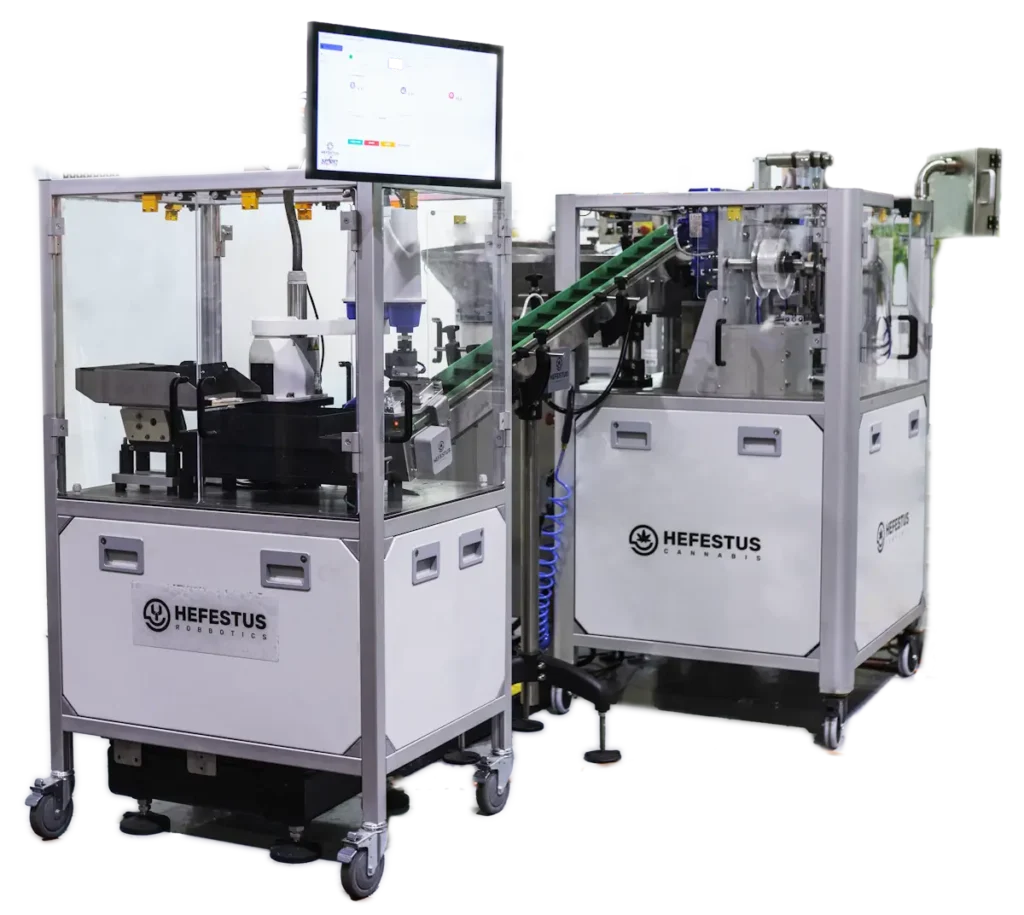
AutoTube seals whatever tube format the line is running.
On March 1, 2026, Ohio banned slide-lock tubes for preroll compliance. Every preroll sold in the state now needs a permanent child-resistant cap. If your line is still filling and capping the old way, you have a real compliance problem, not a theoretical one.
Ohio isn't alone. Minnesota, New York, New Jersey, and Missouri are all tightening their own child-resistant standards, moving toward full CPSC senior-friendly testing instead of the baseline federal minimum. The floor is rising state by state, and it's rising faster than most packaging inventory turns over.
What "child-resistant" actually requires now
The federal standard, ASTM D-3475, sounds simple and isn't. A closure has to be tested on 100 real children under age 5: 85% of them have to fail to open it without being shown how, and 80% have to fail even after a demonstration. "Push down and turn" and squeeze-lock mechanisms are the two designs that reliably clear that bar. A slide-lock tube, the kind Ohio just outlawed, doesn't.
If your current tube supplier can't tell you which ASTM test their closure actually passed and at what pass rate, that's the question to ask before your next order, not after a state inspector asks it for you.
The tube is now a growth bottleneck, not an afterthought
In 2025, prerolls became the single top-selling cannabis category by unit volume: over 383 million units, $3.6 billion in revenue, a 15.9% share of the whole category. Unit sales grew 18.6% year over year, while the broader cannabis market grew only 1.5%. Prerolls are on track to keep growing faster than any other top category through 2030, projected past $5.2 billion.
That growth curve means the tube can't stay a manual step. A rolling line that scales from a few thousand units a day to tens of thousands, the same jump documented in our own Copperstate Farms case study, needs a tubing and labeling step that scales with it. A bottleneck at the tube is the same lost output as a bottleneck at the roller. It just shows up later in the line.
PCR plastic stopped being the compromise option
For years, "sustainable packaging" meant giving something up: durability, clarity, or cost. That's no longer the honest tradeoff. Post-consumer recycled (PCR) plastic tubes now carry real third-party verification through GRS certification, and regulatory recognition under extended producer responsibility laws like California's SB 54. Durability and price are close to, or matching, virgin plastic. If your current packaging decision is still being made as "eco versus practical," that choice has already changed underneath you.
Glass still has a place. It's inert and reads as premium on a shelf, but it's genuinely more fragile in transit, a real tradeoff for a high-volume line shipping at scale, not a marketing detail.
Everyone says airtight. Almost nobody says nitrogen. Every tube supplier's page says some version of "airtight," "moisture-proof," "odor-proof." Almost none of them name the actual mechanism behind it. AutoTube uses medical-grade nitrogen Modified Atmosphere Packaging (MAP), sealing each tube in an inert nitrogen environment before it ever leaves the line, not just a tight-fitting cap. It's a more rigorous freshness mechanism than "airtight" implies, and it's one most of the market isn't even talking about yet.
Where this leaves a producer scaling in 2026
Three questions worth asking before your next tube order: does your current closure actually pass ASTM D-3475, or are you assuming it does. Is your tubing step keeping pace with your rolling line, or quietly capping your real output. And is your packaging material decision current, or still running on a 2020 assumption about what "sustainable" costs you.
AutoTube handles the sealing and the compliance question at once: nitrogen MAP for freshness, built for the closure standards the market is actually moving toward. Weighing a biodegradable format specifically? Check the certification first, most "biodegradable" tubes on the market don't have one.